Atypical Facial Pain (Persistent Idiopathic Facial Pain): Types, Causes & Treatment
Atypical facial pain is a chronic facial pain condition that does not fit the typical pattern of classic trigeminal neuralgia or other well-defined diagnoses. Today, specialists often use the term Persistent Idiopathic Facial Pain (PIFP) for what has traditionally been called atypical facial pain. These terms are closely related and often used together in clinical practice. ICHD-3
For many patients, the journey to a correct diagnosis is long. They see multiple dentists, ENT doctors, and neurologists before they are told that the pain may be neuropathic facial pain rather than a dental or sinus problem.
This page explains what atypical facial pain is, how it differs from trigeminal neuralgia, and how a facial pain specialist or neurosurgeon in New York City may approach diagnosis and treatment.
What is Atypical Facial Pain (Persistent Idiopathic Facial Pain)?
According to international headache and pain classifications, persistent idiopathic facial pain is defined as: ICHD-3+1
Facial or oral pain that is present on most days
Lasts more than 2 hours per day
Persists longer than 3 months
Does not follow a clear nerve pathway
Has no identifiable cause on imaging or exam
Historically, the term atypical facial pain (AFP) was used as a "catch-all" category for facial pain that did not fit trigeminal neuralgia or other well-defined diagnoses. Today, many specialists prefer PIFP, but patients and clinicians still commonly use AFP in everyday language. Wikipedia
In simple terms, atypical facial pain is chronic facial pain without a clear structural cause, and it requires careful evaluation to make sure more treatable conditions are not missed.
Symptoms of Atypical Facial Pain
Patients with atypical facial pain often describe:
Constant or near-constant pain in the face or mouth
Dull, aching, nagging, or pressure-like pain
Sometimes burning, throbbing, or "tight" pain
Pain that may start in one small area and then spread over time
Pain that does not follow one trigeminal nerve branch exactly
Pain that is often one-sided, but can become more widespread
Worsening with stress, fatigue, or poor sleep
Unlike classic trigeminal neuralgia, there are usually no clear “trigger zones” that cause sharp attacks with light touch or chewing. Simple pain relievers rarely give meaningful relief. Wikipedia

Types and Related Conditions
Several facial pain conditions fall into or overlap with the atypical facial pain spectrum:
1. Persistent Idiopathic Facial Pain (PIFP)
Constant or near-constant facial or oral pain
No structural abnormality found
Normal neurological exam
Diagnosis of exclusion after other causes are ruled out ICHD-3+1
2. Atypical Odontalgia ("Phantom Tooth Pain")
Tooth or gum pain without dental disease
Can begin after dental work, such as a filling, root canal, or extraction
Often chronic and difficult to localize
3. Post‑traumatic or Trigeminal Nerve Injury Pain
Facial pain after injury, dental surgery, sinus surgery, or jaw surgery
Evidence or strong suspicion of nerve trauma
4. Other Neuropathic Facial Pain Syndromes
Some chronic facial pains do not fully meet criteria for PIFP but share features of neuropathic pain, such as burning, allodynia (pain to light touch), or sensitivity to temperature.
A facial pain specialist or neurosurgeon will determine which category best fits your symptoms and imaging.
What Causes Atypical Facial Pain?
There is no single cause. Instead, atypical facial pain is believed to reflect a combination of nerve and brain changes that keep the pain system "turned on" even after the original trigger has healed.
Current concepts include: IASP+1
Abnormal sensitization of the trigeminal pain system
The trigeminal nerve carries sensation from the face to the brain.
In atypical facial pain, the nerve and central pain pathways can become oversensitive.
Normal signals may be misread as pain.
Previous local trigger
Dental procedures, sinus surgery, or facial trauma may act as the initial trigger in some patients.
Even after tissues heal, the pain circuits may remain overactive.
Central sensitization and other chronic pain conditions
Many patients with atypical facial pain also have other chronic pain syndromes, such as headaches, neck pain, back pain, or fibromyalgia. Wikipedia+1
This suggests a more global change in how the nervous system processes pain.
Mood and stress factors
Depression, anxiety, and high stress levels are common in patients with PIFP and AFP.
These conditions do not mean the pain is "imagined". Chronic pain changes brain circuits that handle mood, and low mood can also make pain more intense.
Atypical Facial Pain vs Trigeminal Neuralgia
It is important to distinguish atypical facial pain from classic trigeminal neuralgia (TN) because treatments, especially surgical treatments, are very different.
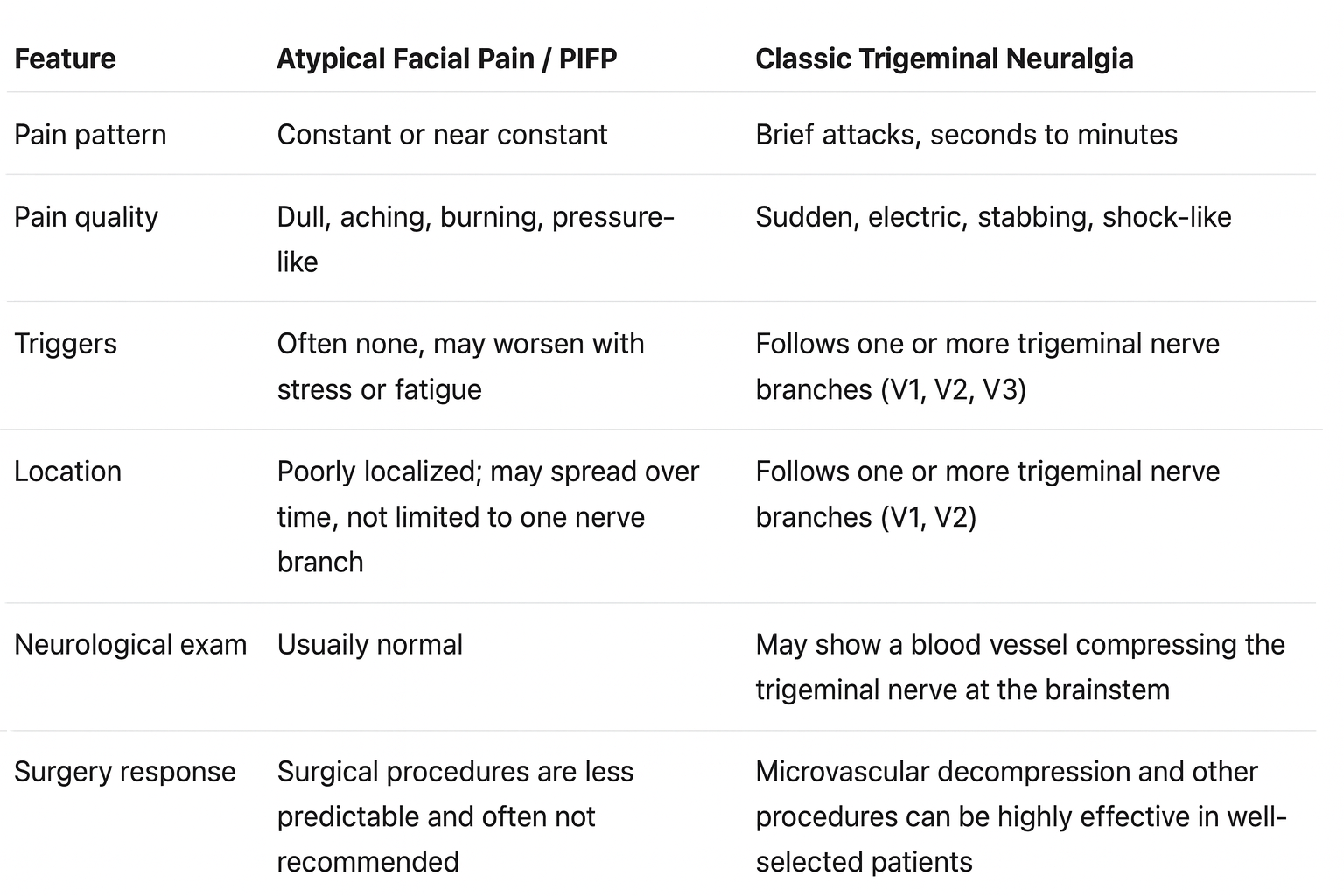
Some patients have features of both, such as constant aching pain with superimposed sharp shocks. These "mixed" cases require careful evaluation by a neurosurgeon or facial pain specialist.
How Atypical Facial Pain Is Diagnosed
There is no single blood test or scan that proves atypical facial pain. It is a clinical diagnosis of exclusion, which means other causes must be ruled out first. orofacialpain.org.uk+1
A typical diagnostic workup may include:
1. Detailed history
Onset, location, and character of the pain
Triggers, relieving factors, and impact on daily life
Past dental work, sinus or jaw surgery, facial trauma
Headache history and other pain conditions
Mood symptoms, sleep, and stress level
2. Neurological and cranial nerve examination
Assessment of facial sensation, strength, and reflexes
Evaluation of eye movements, jaw function, and facial muscles
3. High‑resolution MRI
Brain and skull base MRI with sequences targeted to the trigeminal nerve
Used to rule out structural causes such as tumors, multiple sclerosis, vascular compression, or skull base lesions
4. Dental, ENT, or TMJ evaluation
To exclude dental infection, sinus disease, temporomandibular joint disorders, and other local causes of pain
Only when these conditions are excluded and the pain pattern matches chronic, non-anatomical facial pain can a diagnosis of PIFP or atypical facial pain be made.
Treatment Options for Atypical Facial Pain
Treatment is often multimodal. The goal is to reduce pain intensity, improve function, and enhance quality of life. Complete elimination of pain is possible in some patients but not in all.
1. Education and expectation setting
Clear explanation of the diagnosis and realistic goals
Understanding that the pain is real and related to nerve and brain sensitization, even if imaging is normal
2. Medications
These medications are commonly used for neuropathic (nerve-related) pain:
Tricyclic antidepressants (TCAs)
Examples: amitriptyline, nortriptyline
Often used in low doses at night to help both pain and sleep
Serotonin-norepinephrine reuptake inhibitors (SNRIs)
Examples: duloxetine, venlafaxine
Helpful for neuropathic pain and mood symptoms
Anticonvulsants (antiepileptic drugs)
Examples: gabapentin, pregabalin
Reduce abnormal nerve firing
Doses and combinations are tailored to each patient, taking into account other medical conditions and possible side effects. orofacialpain.org.uk+1
Simple over-the-counter pain relievers (such as acetaminophen or NSAIDs) are usually not sufficient for atypical facial pain on their own.
3. Nerve blocks and local procedures
In selected cases, a pain specialist or neurosurgeon may recommend:
Local anesthetic nerve blocks
Trigger point injections
Injections around branches of the trigeminal nerve
These can provide temporary relief and sometimes help confirm the pain generator.
4. Botulinum toxin (Botox) injections
Botulinum toxin injections can reduce muscle overactivity and may dampen pain signaling in the affected area. This approach is sometimes used for neuropathic facial pain and may be considered when medications alone are not effective.
5. Physical therapy and jaw-focused treatment
If there is coexisting jaw muscle tension or TMJ problems, specialized physical therapy may help reduce mechanical contributors to pain and improve function.
6. Psychological and behavioral pain management
Chronic facial pain affects mood, sleep, and daily activities. Evidence-based treatments such as:
Cognitive behavioral therapy (CBT) for pain
Mindfulness-based stress reduction
Integrated pain management programs
can help patients cope better and reduce the impact of pain on daily life. bisom.org.uk
7. Surgery
For pure atypical facial pain / PIFP, surgery is generally not a first-line treatment and often not recommended, because there is no single compressed nerve to fix. neurosurgery.theclinics.com+1
However, surgery may be considered when:
There is clear evidence of classic trigeminal neuralgia with vascular compression on MRI
There is a skull base or nerve lesion that is surgically treatable
The patient has mixed pain features, and part of the pain is due to a surgically addressable condition
In these cases, a neurosurgeon with expertise in trigeminal neuralgia and skull base tumors can explain surgical risks and expected benefits in detail.
When Should You See a Facial Pain Specialist or Neurosurgeon?
You should seek specialist evaluation if:
You have persistent facial or oral pain lasting more than 3 months
The pain is constant, deep, or aching rather than brief electric shocks
Dental treatments have not relieved the pain, or multiple teeth have been treated or removed without lasting benefit
Imaging so far has been "normal", but pain continues to worsen
You have been told you may have trigeminal neuralgia, but your symptoms do not fully fit the classic pattern
The pain is severely affecting your ability to work, sleep, or enjoy daily life
A specialist can provide a clear diagnosis, rule out serious causes, and coordinate a personalized treatment plan.
Care with Dr. Ramesh P. Babu in New York City
Dr. Ramesh P. Babu is a neurosurgeon in New York City with a focus on:
Trigeminal neuralgia and other cranial nerve disorders
Neuropathic facial pain, including atypical facial pain and PIFP
Skull base tumors and complex microsurgical procedures
For patients with chronic facial pain, his role is to:
Perform a detailed clinical evaluation
Arrange appropriate high-resolution imaging
Distinguish between classic trigeminal neuralgia, PIFP, and other craniofacial pain syndromes
Offer advanced medical and interventional options
Discuss surgical options only when there is a clear structural or nerve target
If you are living with unexplained facial pain and are looking for a facial pain specialist or neurosurgeon in New York City, an evaluation with Dr. Babu can help you understand your diagnosis and explore the most appropriate treatment options.
Important note
This information is provided for educational purposes and does not replace a consultation with a qualified physician. If you have facial pain, you should discuss your individual situation and test results with your treating doctor.